ANI
22 Nov 2025, 11:30 GMT+10
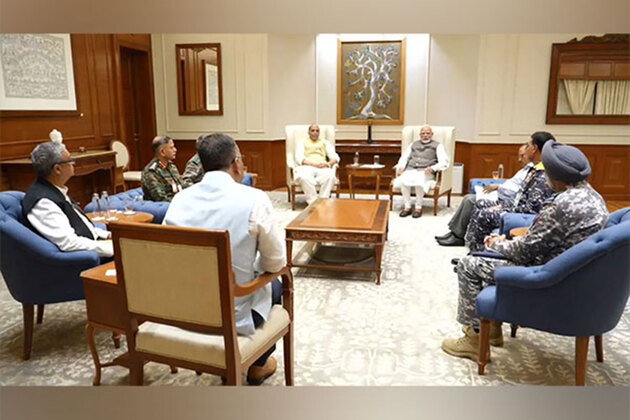
New Delhi [India], November 22 (ANI): India's traditional model of strategic restraint has given way to a sharper, more assertive security doctrine shaped by recent terror crises and shifting public expectations, according to an analysis by authors John Spencer and Lauren Dagan Amoss. Their assessment argues that India has crossed a decisive threshold in how it responds to terrorism, manages escalation with Pakistan, and signals deterrence to both Islamabad and Beijing.
The authors note that India had already begun moving away from the vocabulary of restraint over the past decade, as a series of major Pakistan-based terrorist attacks, including Uri in 2016, Balakot in 2019 and Pahalgam in 2025, showed that limited and predictable responses did little to deter cross-border militancy. They say predictability encouraged terrorist groups to prepare for subsequent attacks, weakening the belief that terrorism could be contained below the level of interstate conflict.
According to their assessment, Operation Sindoor crystallised this ongoing transformation. India no longer waits for lengthy attribution processes or international validation before acting. It has embraced a doctrine rooted in coercive clarity and readiness to strike first if citizens are threatened. Long-range fires, drone swarms, loitering munitions and real-time integrated intelligence used during the operation reflected a new operating logic rather than a one-off shift.
They observe that the earlier assumption that restraint prevents escalation has been overturned. Groups backed by Pakistan's security establishment exploited the gap between terrorism and overt state aggression, anticipating that India would avoid forceful retaliation. Limited responses created discernible patterns, which the authors argue invited further violence.
In place of this, India has adopted a doctrine of compellence, treating major attacks as acts of war. This approach was formalised during Operation Sindoor when the leadership made clear that such attacks would no longer be handled as law-enforcement matters. Pre-emption has become an accepted sovereign right, underscoring a doctrinal shift that the authors describe as institutional rather than episodic.
They add that India's deterrence posture is now pattern-based instead of tied to specific events. Public expectations have hardened, narrowing the political space for restraint as citizens increasingly demand retaliation rather than investigation. This domestic sentiment, they note, is shaping national security strategy.
The shift also extends into diplomacy. During the 2025 ceasefire discussions with Pakistan, India rejected all external mediation, reflecting what the authors call a new doctrinal principle. Crises with Pakistan are treated as regionally internal, with communication routed directly through the Directors General of Military Operations. External involvement is kept minimal to preserve strategic autonomy.
Treaty management has undergone a similar reorientation. The suspension of the Indus Waters Treaty, a 1960 agreement long viewed as a stabilising feature of India-Pakistan relations, represented the deliberate use of resource-sharing frameworks as coercive leverage. The authors state that arrangements once considered stabilising anchors are now judged solely on whether they reinforce India's security interests. Airspace, border management and water agreements are treated through this lens.
They also note that foundational diplomatic instruments, such as the 1972 Shimla Agreement, carry diminished weight, as India sees them as imposing more constraints on its actions than on Pakistan's.
On nuclear doctrine, India continues to publicly uphold No First Use, but political leaders have introduced calibrated ambiguity to adapt to evolving threats. The authors describe a shift from assured retaliation to assured punishment aimed at reducing adversary miscalculation while retaining rhetorical restraint. With MIRV capabilities, canisterised missiles at higher readiness and regular SSBN patrols, India's nuclear deterrent is increasingly oriented towards readiness rather than symbolism.
Precision conventional strikes near Pakistan's nuclear command-and-control systems have further narrowed the conventional-nuclear divide.
The authors highlight a major transformation in counterterrorism doctrine as well. Proxy groups are treated as instruments of state policy, and India's concept of zero tolerance now extends not only to preventing attacks but also to dismantling the entire ecosystem that enables them. Networks surrounding terrorist groups are viewed as legitimate targets.
A parallel audience for these actions, they say, is China. Signals intended for Pakistan simultaneously convey messages to Beijing. During Operation Sindoor, India's interception of Chinese-origin PL-15 air-to-air missiles and its neutralisation of Chinese-supplied air defence systems provided insight into Chinese weapons design and vulnerabilities. They note that India's evolving deterrence logic is designed for a two-front environment.
The overall picture, they conclude, is of a state recalibrating its security paradigm under sustained pressure. India is not behaving recklessly, they argue, but coherently, aligning doctrine, public sentiment, defence industrial capacity and geopolitical communication around a single principle. They state that security must be secured by India itself, not guaranteed by external mediation or constrained by outdated assumptions.
They affirm that India has effectively drafted a new playbook for national security, and the world must adapt to this emerging paradigm.
After the April 22 terror attack in Kashmir's Pahalgam in which Pakistan-backed terrorists killed at least 26 people in the name of religion, the Indian Armed Forces launched Operation Sindoor in the early hours of May 7, targeting terror camps operated by Jaish-e-Mohammed and Lashkar-e-Taiba in Pakistan and Pakistan-Occupied Kashmir (PoK) through precision strikes. India also repelled subsequent Pakistani escalation and pounded its airbases. (ANI)
Get a daily dose of Chile Sun news through our daily email, its complimentary and keeps you fully up to date with world and business news as well.
Publish news of your business, community or sports group, personnel appointments, major event and more by submitting a news release to Chile Sun.
More InformationMadurai (Tamil Nadu) [India], November 25 (ANI): As excitement builds ahead of the FIH Hockey Men's Junior World Cup Tamil Nadu 2025,...
(251125) -- DOHA, Nov. 25, 2025 (Xinhua) -- Players of Brazil look dejected following defeat during the penalty-shoot-out at the semifinal...
(251124) -- PASIG CITY, Nov. 24, 2025 (Xinhua) -- Players of Argentina celebrate after scoring a goal during the group A match between...
Jair Bolsonaro was recently detained after months under house arrest while appealing his 27-year sentence for plotting a coup ...
New Delhi [India], November 24 (ANI): Bharatiya Janata Party (BJP) National Spokesperson CR Kesavan on Minday accused the Congress...
Cincinnati [USA], November 24 (ANI): FIFA World Cup-winning Argentina football legend Lionel Messi stands one step closer to his first-ever...
NEW YORK CITY, New York: New research released on November 17 shows that enrollment of new international students at U.S. universities...
Peshawar [Pakistan], November 25 (ANI) The ongoing tussle between the federal and Khyber-Pakhtunkhwa (K-P) governments has plunged...
Sindh [Pakistan] November 25 (ANI): As Sindh moves to procure wheat for the 2025-26 season, the provincial government's indecision...
Washington DC [US], November 25 (ANI): US President Donald Trump has said that he will travel to China in April at the invitation of...
London is counting on arms contracts fueling the Ukraine conflict and wont let the US just put and end to it, the SVR has warned ...
SHARJAH, 25th November, 2025 (WAM) -- The University of Sharjah's (UoS) Alumni Association has inaugurated the Executive Committee...