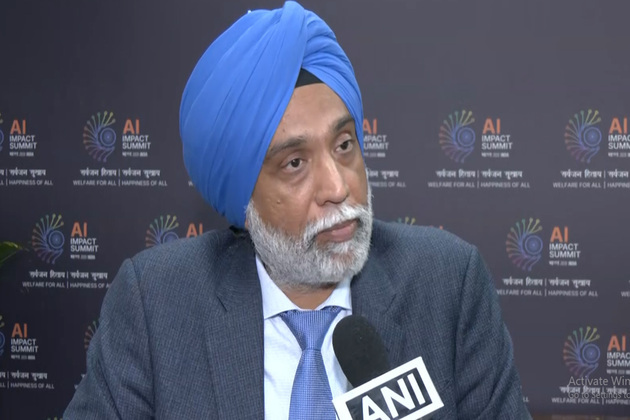
New Delhi [India], February 17 (ANI): Amandeep Singh Gill, United Nations Under Secretary-General and United Nations' Special Envoy for Digital and Emerging Technology, said that the India AI Summit is a crucial way of having an inclusive conversation on Artificial Intelligence.
Gill, while talking to ANI, said that this is also important as the UN organised a first-ever international panel on AI.
'I think it's a tremendous opportunity to have a more inclusive conversation about governing AI, harnessing its opportunities, managing its risks. It's also an exciting moment for us at the United Nations because we just adopted these decisions on setting up the first-ever international independent scientific panel on AI, the first global dialogue on AI governance. So the complementarity between the summit's agenda and the UN's agenda is real and we see this summit accelerating some of the progress that the international community is making on governing artificial intelligence for all of humanity,' he told ANI.
Gill further said that a policy needs to be informed by evidence and independent assessment.
'Our first message is that policy needs to be informed by evidence, by science, by independent assessments, neutral assessments of the direction, the implications of this technology. Our second message is that the world needs to cooperate on the guardrails. It's a powerful technology,' he said.
Gill further said that the field AI has immense capacity and India is paying attention to something that the world is talking about.
'It has opportunities, but it also has risks of exclusion, bias, discrimination, reinforcing inequalities in societies and in economies, impact on children's well-being, so all of that requires careful, wise responses. Not to throttle innovation, but to guide innovation in the right direction. And our final message is that we need massive investments in readiness in societal, individual, and institutional capacity to both govern AI and harness it for its benefits. So this AI capacity building, which fortunately India is also paying a lot of attention to something that the world urgently needs and we hope from the summit we come out with a strong message on that,' he said.
He added further that India's enormous talent pool started to reinforce that talent development by talking about AI.
'I think by working together with other countries not just in the global south but countries that are struggling to get ahead in the AI development effort. So by sharing its experience, the digital public infrastructure, by reinforcing interoperability, by sharing use cases, by working together with other countries in similar situations on data sets that work in domains like agriculture, health, and education, and also reinforcing the human capacity, the talent development. India has an enormous talent pool, and it has started to reinforce that talent development. And I think these are all areas where India can work with the rest of the world,' he said.
Gill also underlined the UN's committment to AI, saying that UN Secretary General Antonio Guterres is determined to roll out funds for building AI capacity.
'So the Secretary General has come out with concrete options for building AI capacity, a global fund on AI of up to $3 billion to invest in 80, 90 countries that are most at risk of getting left behind, a global network of AI capacity building centers to which India has kindly offered a center as well. So those are the areas that we hope governments as well as private sector and philanthropic organizations would put an emphasis on,' he said.
He further said that having local language data sets protects one's sovereignty in the field of AI.
'Sovereignty in AI depends on what stage a particular country is local language. So I think a good starting point is always local language data sets. Also developing the local talent to absorb and apply artificial intelligence, take open source models and tune them in context. A critical aspect, another critical aspect of Sovereignty is having access to the infrastructure, not just the compute, but also inference in terms of data centres as well as the energy infrastructure that's needed beyond it. There are high-level considerations in sovereign AI, building foundation models, etc,' he said.
'But I think a quick start in terms of diffusion of AI applications into the wider economy is always helpful even as you focus on developing sovereign large language models and I would say from a UN perspective, based on the analysis of the high level advisory body of the sector general on AI, we believe that models with let's say small language models, not large language models, 50 to 70 billion parameters, not these, know, thousands of billions of parameters, they have the most relevance,' he added.
Gill then said that India is taking the lead in AI capacity building, adding, 'So these are the areas where countries that are desirous of building their own AI, strengthening resilience, and strengthening sovereign choices should be focusing on. I mentioned the AI capacity building effort where India is taking the lead along with 14 other countries as of now but I think also in terms of managing the misuse of AI, you know, impact on children's well-being impact on inequalities, the disruption of labour markets.'
He further highlighted how there is immense potential for India and UN to collaborate. 'There is a lot that India and the United Nations can do together. Finally, would say this is an area where the UN is already engaged with India on, and this is South-South cooperation, cooperation which is also called triangular cooperation, South-South-North cooperation, where some of India's experience with digital public infrastructure, for instance, and improving government services can be shared with other countries. Likewise, lessons from other countries can be channeled to where the needs are. I think we should make AI work for all humanity,' he said.
Gill said that AI should be equitable and empowering to its users.
'The Secretary General says AI should not stand for advancing inequality. So more equitable and empowering development of AI. The Secretary General has attended each of the previous three summits. It has been part of his personal agenda, his vision to advance international cooperation on AI,' he said.
He emphasised the need to reskill as AI is posing a danger of job losses.
'There could be new jobs opening up, new opportunities, new sectors of the economy opening up, but definitely some sectors where you have employment today, the numbers will go down. Software is already seeing some impacts. So I think the challenge is, how do we anticipate the impact? How do we respond to it through skilling, re-skilling, supporting the transition ensuring that there's a safety net for those who are getting impacted adversely and societies will have to work on reinterpreting the social contract between the private sector employers employees etc and the UN you know we have the International Labour Organization it has a tripartite approach it has been doing some research on AI's impact on particular sectors you know my office has also contributed to those assessments so we need to work together to anticipate and then to respond with changes in policy, changes in education, training and skilling programs,' he added.
Meanwhile, from data ethics to a profound environmental and geopolitical challenge, global policy experts agree that AI cannot exist in a vacuum and must be synchronised with the global drive for decarbonization and regional cooperation.
'I think it's a tremendous opportunity to have a more inclusive conversation about governing AI, harnessing its opportunities, managing its risks. It's also an exciting moment for us at the United Nations because we just adopted these decisions on setting up the first-ever international independent scientific panel on AI, the first global dialogue on AI governance. So the complementarity between the summit's agenda and the UN's agenda is real, and we see this summit accelerating some of the progress that the international community is making on governing artificial intelligence for all of humanity,' he told ANI.
Gill further said that a policy needs to be informed by evidence and independent assessment, adding, 'Our first message is that policy needs to be informed by evidence, by science, by independent assessments, neutral assessments of the direction, the implications of this technology. Our second message is that the world needs to cooperate on the guardrails. It's a powerful technology.'
Gill further said that the field AI has immense capacity and India is paying attention to something that the world is talking about.
'It has opportunities, but it also has risks of exclusion, bias, discrimination, reinforcing inequalities in societies and in economies, impact on children's well-being, so all of that requires careful, wise responses. Not to throttle innovation, but to guide innovation in the right direction. And our final message is that we need massive investments in readiness in societal individual institutional capacity to both govern AI and harness it for its benefits. So this AI capacity building, which fortunately India is also paying a lot of attention to something that the world urgently needs and hope from the summit we come out with a strong message on that,' he said.
Gill said that India's enormous talent pool started to reinforce that talent development by talking about AI.
'I think by working together with other countries not just in the global south but countries that are struggling to get ahead in the AI development effort. So by sharing its experience, the digital public infrastructure, by reinforcing interoperability, by sharing use cases, by working together with other countries in similar situations on data sets that work in domains like agriculture, health, and education, and also reinforcing the human capacity, the talent development. India has an enormous talent pool, and it has started to reinforce that talent development. And I think these are all areas where India can work with the rest of the world,' he said.
He further said that UN Secretary General Antonio Guterres is determined to roll out funds for building AI capacity.
'So the Secretary General has come out with concrete options for building AI capacity, a global fund on AI of up to $3 billion to invest in 80, 90 countries that are most at risk of getting left behind, a global network of AI capacity building centers to which India has kindly offered a center as well. So those are the areas that we hope governments as well as private sector and philanthropic organizations would put an emphasis on,' he said.
He further said that having local language data sets protects one's sovereignty in the field of AI.
'Sovereignty in AI depends on what stage a particular country is local language. So I think a good starting point always is local language data sets. Also developing the local talent to absorb and apply artificial intelligence, take open source models and tune them in context. A critical aspect, another critical aspect of Sovereignty is having access to the infrastructure, not just the compute, but also inference in terms of data centers as well as the energy infrastructure that's needed beyond it. There are high level considerations in sovereign AI, building foundation models, etc,' he said.
'But I think a quick start in terms of diffusion of AI applications into the wider economy is always helpful even as you focus on developing sovereign large language models and I would say from a UN perspective, based on the analysis of the high level advisory body of the sector general on AI, we believe that models with let's say small language models, not large language models, 50 to 70 billion parameters, not these, know, thousands of billions of parameters, they have the most relevance,' he added.
Gill then said that India is taking the lead in AI capacity building.
'So these are the areas where countries that are desirous of building their own AI, strengthening resilience, strengthening sovereign choices should be focusing on. I mentioned the AI capacity building effort where India is taking the lead along with 14 other countries as of now, but I think also in terms of managing the misuse of AI you know impact children's well-being, impact on inequalities, the disruption of labour markets. There is a lot that India and the United Nations can do together. Finally, would say this is an area where the UN is already engaged with India on, and this is South-South cooperation, cooperation which is also called triangular cooperation, South-South-North cooperation, where some of India's experience with digital public infrastructure, for instance, and improving government services can be shared with other countries. Likewise, lessons from other countries can be channelled to where the needs are. I think we should make AI work for all humanity,' he said.
Gill said that AI should be equitable and empowering to its users.
'The Secretary General says AI should not stand for advancing inequality. So, more equitable and empowering development of AI. The Secretary General has attended each of the previous three summits. It has been part of his personal agenda, his vision to advance international cooperation on AI. So he'll be very happy to work with the hosts, India and France, to align these efforts more and more with these global mechanisms on the governance of AI,' he said.
He emphasised the need to reskill as AI is posing a danger of job losses.
'There could be new jobs opening up, new opportunities, new sectors of the economy opening up, but definitely some sectors where you have employment today, the numbers will go down. Software is already seeing some impacts. So I think the challenge is, how do we anticipate the impact? How do we respond to it through skilling, re-skilling, supporting the transition ensuring that there's a safety net for those who are getting impacted adversely and societies will have to work on reinterpreting the social contract between the private sector employers employees etc and the UN you know we have the International Labour Organization it has a tripartite approach it has been doing some research on AI's impact on particular sectors you know my office has also contributed to those assessments so we need to work together to anticipate and then to respond with changes in policy, changes in education, training and skilling programs,' he said.
Meanwhile, from data ethics to a profound environmental and geopolitical challenge, global policy experts agree that AI cannot exist in a vacuum and must be synchronised with the global drive for decarbonization and regional cooperation. (ANI)



 Share
Share
 Tweet
Tweet
 Share
Share
 Flip
Flip
 Email
Email